Open research positions
Overview
PhD position on zero-shot cooperation between heterogeneous robots
Research context
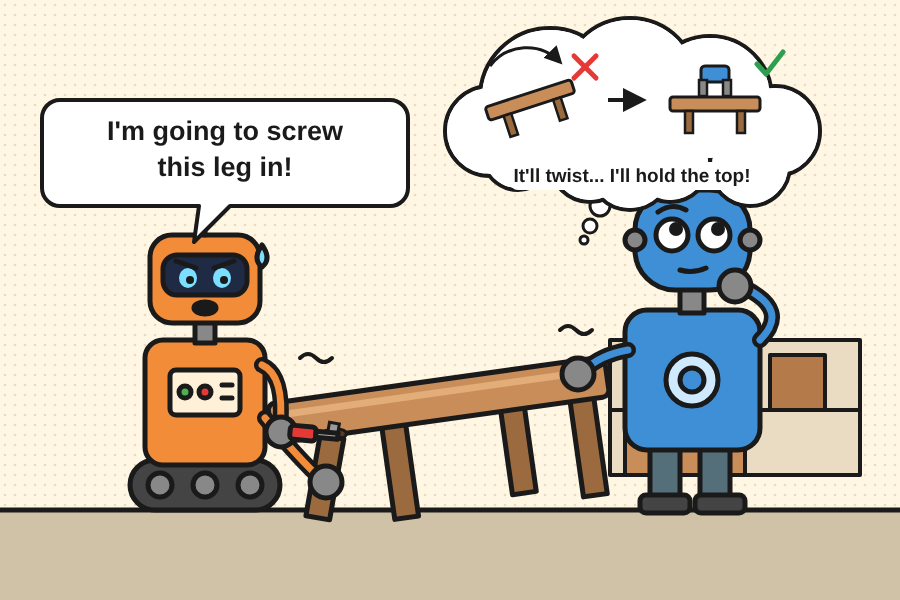
Robots are breaking out of their cages and into warehouses, factories and logistics hubs that they share with other robots, automated machinery and humans. These agents increasingly come from different vendors, have different bodies and controllers, and were never trained together. Our long-term goal is a robot that can act as a spontaneous, ad-hoc teammate in such a setting: one that notices that another agent is about to lift, push or assemble something and provides the right support, or, conversely, recognizes that its own task is about to fail and asks for help. This capability, known as zero-shot cooperation or ad hoc teamwork, has so far been studied mainly in abstract multi-agent settings; bringing it to physical robots with different embodiments, acting on real objects under real physics, is largely uncharted.
Today’s robot foundation models are built for a world without partners. Vision-language-action policies and world models are trained almost exclusively on single-robot data, in which any other agent is simply part of the scene. This cannot be fixed by scaling the data: the right cooperative action depends on the partner’s unobserved goal, and every new partner brings its own goals and behaviour, so the space of partners is open-ended. What is needed is a robot that reasons about its partner: that holds beliefs about what the partner intends and can do, updates them from everything it observes, including what the partner says, and chooses its own actions and messages accordingly.
Research objectives
This PhD addresses the fundamental questions that arise when individually autonomous robots, each with its own goals, body and model of the world, have to cooperate without having been designed or trained together. Our working hypothesis is that cooperation becomes tractable when robots reason not about each other’s bodies or behaviour, but about intended effects on the world, which are constrained by physics and the task and mean the same thing regardless of who brings them about. We will approach this with generative world models and information-theoretic reasoning, in which beliefs about the partner are maintained explicitly and both physical actions and messages are chosen for what they achieve and for the uncertainty they resolve.
Within this frame, a plethora of research questions opens up: how two agents can share a representation of goals and their consequences without sharing a training history, how a robot can infer what an unfamiliar partner is able to do, how it recognizes early enough that a plan, its own or its partner’s, is about to fail, and when it should communicate rather than observe or act, and how what it hears should update its beliefs rather than be executed as a command. Which of these questions you tackle first, and how deep you go into each, will be shaped by your own interests and by the demonstrators you build.
Candidate profile
We offer a fully funded position that can be extended up to 6 years, conditional on positive intermediate evaluations. Your job will consist of 50% research and 50% teaching assistance. Candidates should thus have equal interest in both aspects of the position.
We are looking for a candidate with a master’s degree in computer science, robotics, or a related field, a strong background in machine learning and/or robotics, and solid programming skills. Experience with robot learning, world models, multi-agent systems, probabilistic modelling, simulation (Isaac Sim, MuJoCo) or ROS is a plus, but not a necessity.
How to apply?
Please send your motivation and your CV to pieter.simoens@ugent.be. Your CV should contain a list of projects and/or publications. Last-year master’s students are also welcome to apply.
We read every application ourselves, and applications that do not engage with this specific position will be disregarded. Show us, in your own words, what draws you to this topic, which aspect of the research context you find most interesting or most questionable, and how your background prepares you for it. A motivation letter is fine, but feel free to choose another form that conveys this better, such as a short motivation video of two to three minutes.